

The Best Supermemory AI Alternatives in 2026: 7 Top Picks
Top AI memory alternatives to Supermemory for 2026. From open-source agent layers to cross-platform tools that carry your context.


Supermemory has built one of the most talked-about AI memory tools of 2026. It works as a memory layer for AI agents and apps, with a developer API, a consumer app, an MCP server, and integrations with Claude Code and other coding agents. It tops several public benchmarks for memory recall.
It is not the right fit for everyone, though. Some teams need a memory tool that just works inside ChatGPT and Claude without code. Some need open source. Some are building developer infrastructure and need a different memory model. The "memory layer for AI" category covers a wide range of tools that solve overlapping problems in different ways.
Here are seven worth checking before you commit to one.
Why People Look for Supermemory Alternatives
A few patterns come up regularly when people search for an alternative.
Token-based pricing is hard to predict. Supermemory bills in SM tokens, which deduplicate and discount repeats, but new users still find it harder to forecast cost than a flat monthly plan.
Developer-first positioning. Supermemory's main product is an API and SDK. The consumer app exists but is not the focus. Users who only want memory across ChatGPT, Claude, and Gemini, with no code, are not the primary audience.
Locked into Supermemory's stack. If you want a specific memory model (temporal knowledge graph, OS-style memory tiers, knowledge graph reasoning), other tools are built around those approaches from the ground up.
Cross-platform consumer use. If your actual problem is "I switch between ChatGPT, Claude, Gemini, and Grok and my memory does not move with me," you want a tool built for that, not a developer infrastructure platform.
The seven below cover the main shapes of alternatives.
At a Glance: The Top 7 Supermemory Alternatives
1. MemoryPlugin
Pricing: Core $79/year, Pro $149/year, Core Lifetime $200, Pro Lifetime $400 | Free Trial: 7-day trial, 14-day refund | Platforms: Chrome, Safari, MCP, TypingMind, API
MemoryPlugin adds a persistent memory layer that works across ChatGPT, Claude, Gemini, Grok, Perplexity, and 14 other AI platforms. Instead of building memory for one tool, it sits outside any single AI and carries your context wherever you go.
If Supermemory is built primarily for developers wiring memory into agents and apps, MemoryPlugin is built for the person who actually uses ChatGPT, Claude, and Gemini every day and is tired of explaining themselves to each one separately.
Memory is stored outside each AI's context window. You can see what is saved, edit it, and delete it. Memory is retrieved selectively for each conversation, so prompts stay lean.
Top Features
Buckets organize memories by project, client, or area of your life. Each chat pulls only from the bucket that applies, so unrelated context does not bleed in.
Chat History imports your full chat history and makes it searchable in natural language. You can ask "the chat where I worked out Q3 pricing" and find it.
Files lets you upload documents and query them alongside your memories. No re-uploading per chat.
Cross-platform is the differentiator. The same memory works in ChatGPT, Claude, Gemini, Grok, Perplexity, and more. You do not rebuild context for each tool.
Smart Memory uses automatic categorization to keep prompts lean as your memory grows.
Multiple integrations. Browser extension for ChatGPT, Claude, Gemini, and others. MCP server for Claude Desktop, Cursor, Windsurf. TypingMind plugin. Custom GPT and API.
MemoryPlugin Pros and Cons
MemoryPlugin Pricing
- Core: $79/year: unlimited AI memory, shared memory across platforms, Smart Memory, Memory Buckets, Chat History Import from 1 platform
- Pro: $149/year: unlimited Chat History Import from all 6 platforms, high-accuracy recall, priority access to new features, higher usage limits
- Lifetime: $400 one-time - permanent access to Pro features
Why Choose MemoryPlugin
MemoryPlugin is the right pick if your problem is using AI tools, not building them. Supermemory and the developer-focused options below are designed for engineers shipping agents. MemoryPlugin is designed for the person who lives in chat interfaces and wants their context to be portable.
It also solves the one thing Supermemory's consumer app does not: the same memory working across every major AI tool, not just the ones Supermemory chooses to support.
2. Mem0
Pricing: Free / Starter $19 - month / Pro $249 - month | Free Trial: Free tier with 10K memories | Platforms: Python, TypeScript, MCP, 21+ frameworks
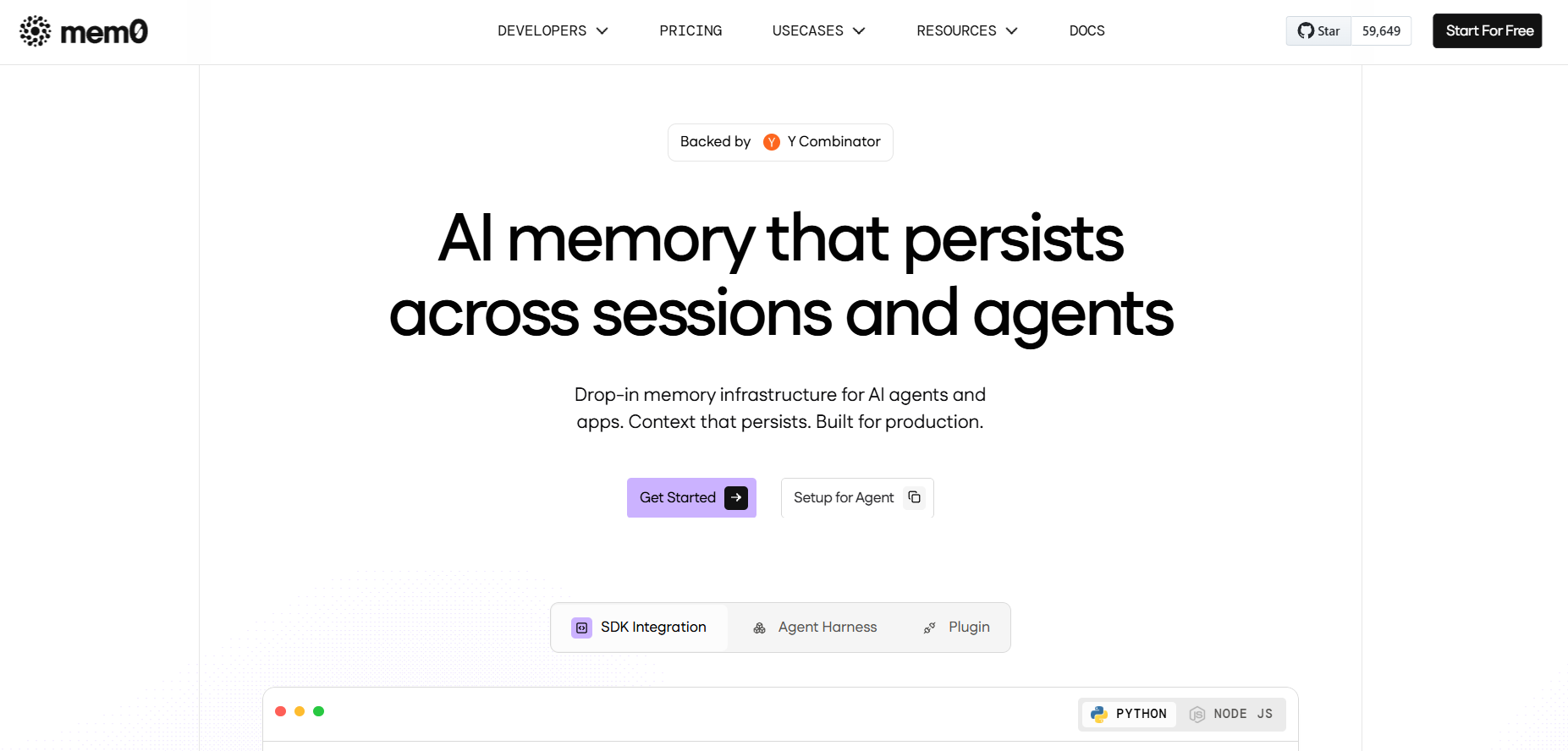
Mem0 is the most widely adopted open-source memory layer for AI agents. With approximately 60,000 GitHub stars and support for Python and JavaScript, it is the default choice for developers who need a memory layer they can fully control.
Unlike Supermemory, Mem0 is open source under Apache 2.0. You can self-host it, audit the code, or use the managed cloud. It provides a three-tier memory system spanning user, session, and agent scopes, plus a self-editing model that resolves conflicting facts automatically.
Top Features
Memory Compression Engine condenses chat history into compact, token-efficient memories.
Multi-Signal Retrieval surfaces the right memories using vector search, graph traversal, and key-value lookups.
User-Scoped Memory keeps each user's preferences and history separate and addressable by ID.
Graph Memory is available on Pro, enabling entity relationships and multi-hop queries.
Compliance: SOC 2 Type I available on enterprise plans.
Mem0 Pros and Cons
Mem0 Pricing
- Free: 10,000 memories and 1,000 retrievals per month
- Starter: $19/month - 50,000 memories
- Pro: $249/month - up to 500,000 memories. Plus graph memory
- Enterprise: Custom pricing
When to Pick Mem0 Over Supermemory
If you are building an AI agent and want an open-source memory layer with broad framework support. Mem0 is easier to drop into an existing LangChain or LangGraph stack than Supermemory's more opinionated platform.
3. Letta (formerly MemGPT)
Pricing: Free tier (3 agents) / Pro $20/mo | Free Trial: Free tier available | Platforms: Python, TypeScript, desktop app
Letta is the open-source stateful agent framework that grew out of the MemGPT paper from UC Berkeley. Its model treats the LLM like an operating system, with the agent managing its own memory tiers through tool calls.
Where Mem0 and Supermemory are memory layers you add to your agent, Letta is the agent framework itself, with memory as a first-class part of the design.
The MemGPT lineage is the reason to care. The paper introduced the idea that the model should decide what to keep in working memory versus what to archive, and Letta is the most mature implementation of that idea.

Top Features
Tiered memory: Core memory is always in-context (like RAM). Recall memory holds conversation history, searchable on demand. Archival memory is an external vector store the agent queries explicitly.
Self-editing memory: The agent has tools to read and write its own memory blocks. The model decides what is worth keeping hot.
Model-agnostic: Works with OpenAI, Anthropic, Mistral, and local models.
Persistent by default: State is stored in databases rather than Python variables, so agents survive across restarts.
Letta Code: A memory-first coding agent built on the Letta platform.
Letta Pros and Cons
Letta Pricing
- Free: 3 agents with managed state, bring your own API keys
- Pro: $20/month — up to 20 stateful agents, Letta Auto weekly and monthly quota
- Max Lite: $100/month — higher usage limits
- Enterprise: Custom pricing
When to Pick Letta Over Supermemory
If you are building agents that need to learn across sessions and decide what to remember themselves. Letta gives the model active control over its own memory, which Supermemory does not.
4. Zep
Pricing: Free tier / Flex $125 - month / Flex Plus $375 - month | Free Trial: Free tier available | Platforms: Python, TypeScript, REST API
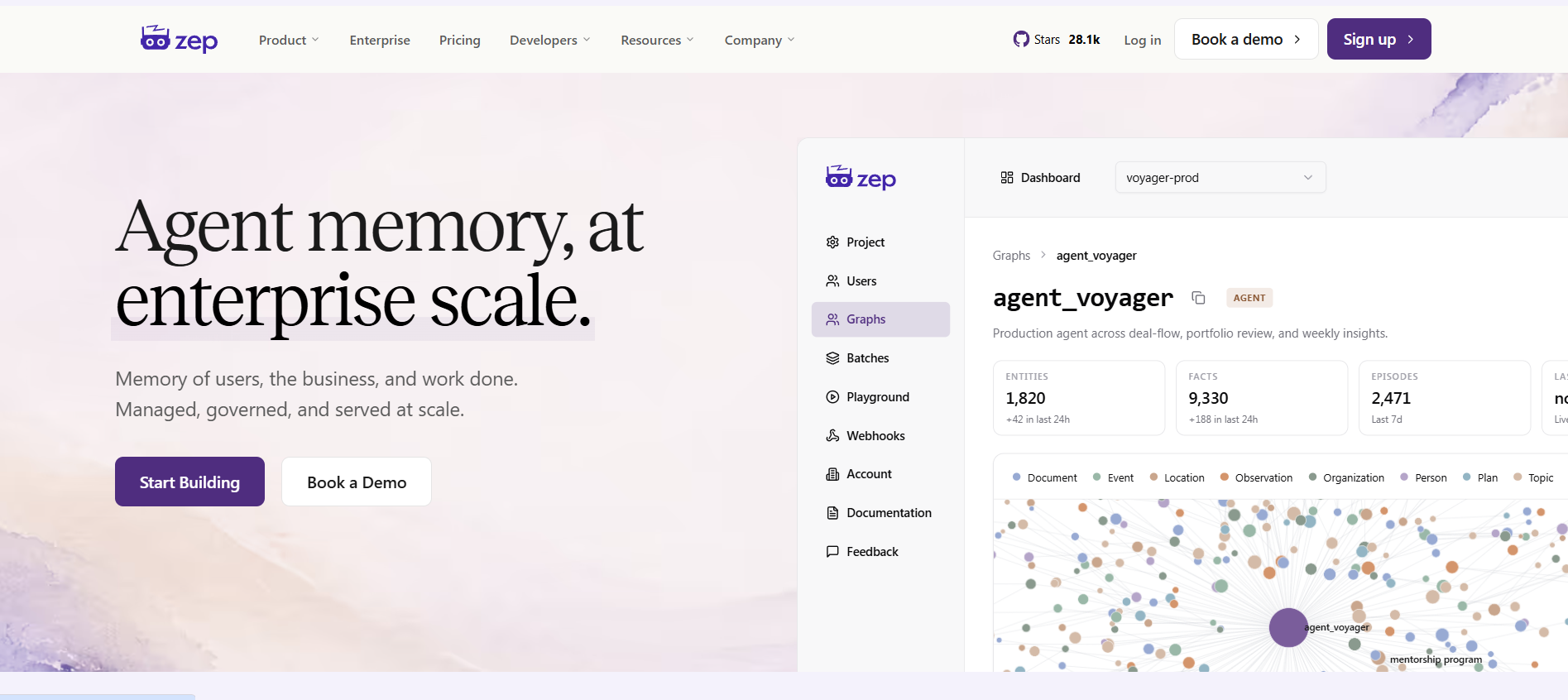
Zep is built around temporal knowledge graphs. Where most memory tools store facts as snapshots, Zep stores each fact with a validity window, so the agent can reason about when something was true.
If your agent needs to know that a user's job title in March is different from their job title now, Zep is built for that case. The underlying engine, Graphiti, is open-sourced separately.
Independent benchmarks on LongMemEval show Zep outperforming Mem0 on temporal reasoning tasks by a wide margin, though Mem0 is broader in framework support.
Top Features
Temporal knowledge graph: Every fact is stored with a validity window. The agent can answer "what was true then" versus "what is true now."
Graphiti engine: Open-source temporal graph that powers Zep's memory. You can use Graphiti standalone if you want the engine without the platform.
Per-session and per-user memory: Standard scoping for multi-tenant agent applications.
Multi-LLM backends: OpenAI, Anthropic, and others.
Zep Pros and Cons
Zep Pricing
- Free: 10,000 credits per month
- Flex: $25/month
- Flex Plus: $475/month
- Enterprise: Custom pricing
When to Pick Zep Over Supermemory
If your agent needs to reason about changing facts over time. Customer support bots tracking case history, sales agents tracking deal state, anything where "when" matters as much as "what."
5. Cognee
Pricing: Free tier / Paid plans | Free Trial: Free tier available | Platforms: Python, MCP
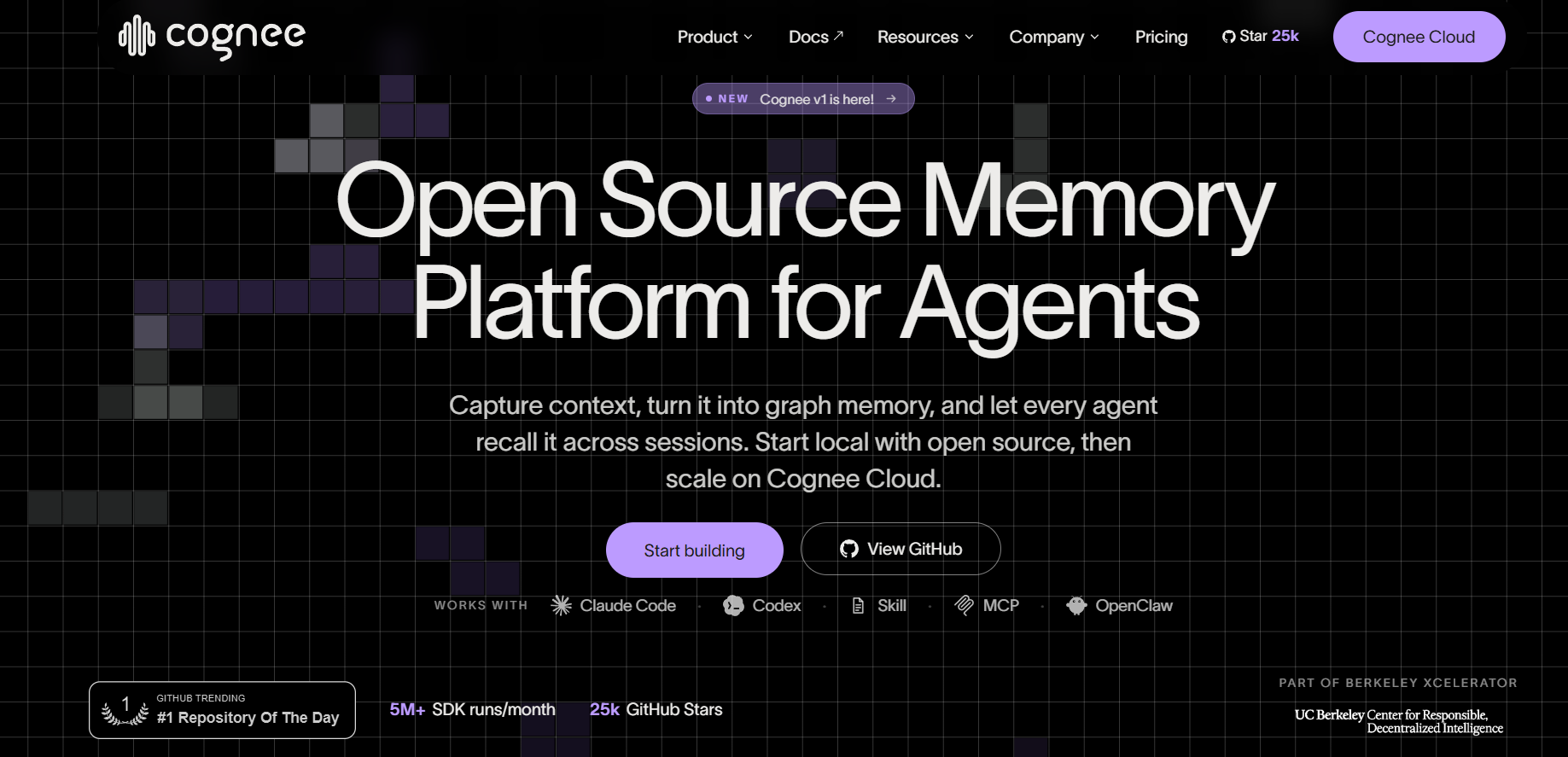
Cognee is an open-source memory framework built around knowledge graphs. It ingests data, extracts entities and relationships, and stores them as a graph the agent can traverse.
The pitch is that flat vector search misses relationships. If you store "Sarah works at Acme" and "Acme acquired BetaCorp" as isolated facts, you cannot easily answer "what company does Sarah ultimately work for?" Cognee builds the graph that links those facts, so the agent can follow the chain.
Top Features
Knowledge graph by default: Entities and relationships extracted automatically from your data.
Multi-hop reasoning: Agents can follow chains of relationships, not just match on similarity.
Open source: Self-hostable, with a managed option.
Pipeline approach: Separate ingestion, processing, and retrieval stages you can customize.
Cognee Pros and Cons
Cognee Pricing
Cognee offers a free tier for self-hosted users. Paid plans unlock more capacity, advanced features, and higher usage limits. Team plans add collaboration features and access management.
When to Pick Cognee Over Supermemory
If your data has rich relationships you want the agent to reason over. Knowledge bases, organizational data, scientific or legal domains where the connections between facts matter more than the facts in isolation.
6. Pieces
Pricing: Free / Pro plan | Free Trial: Free tier available | Platforms: macOS, Windows, Linux, IDE plugins
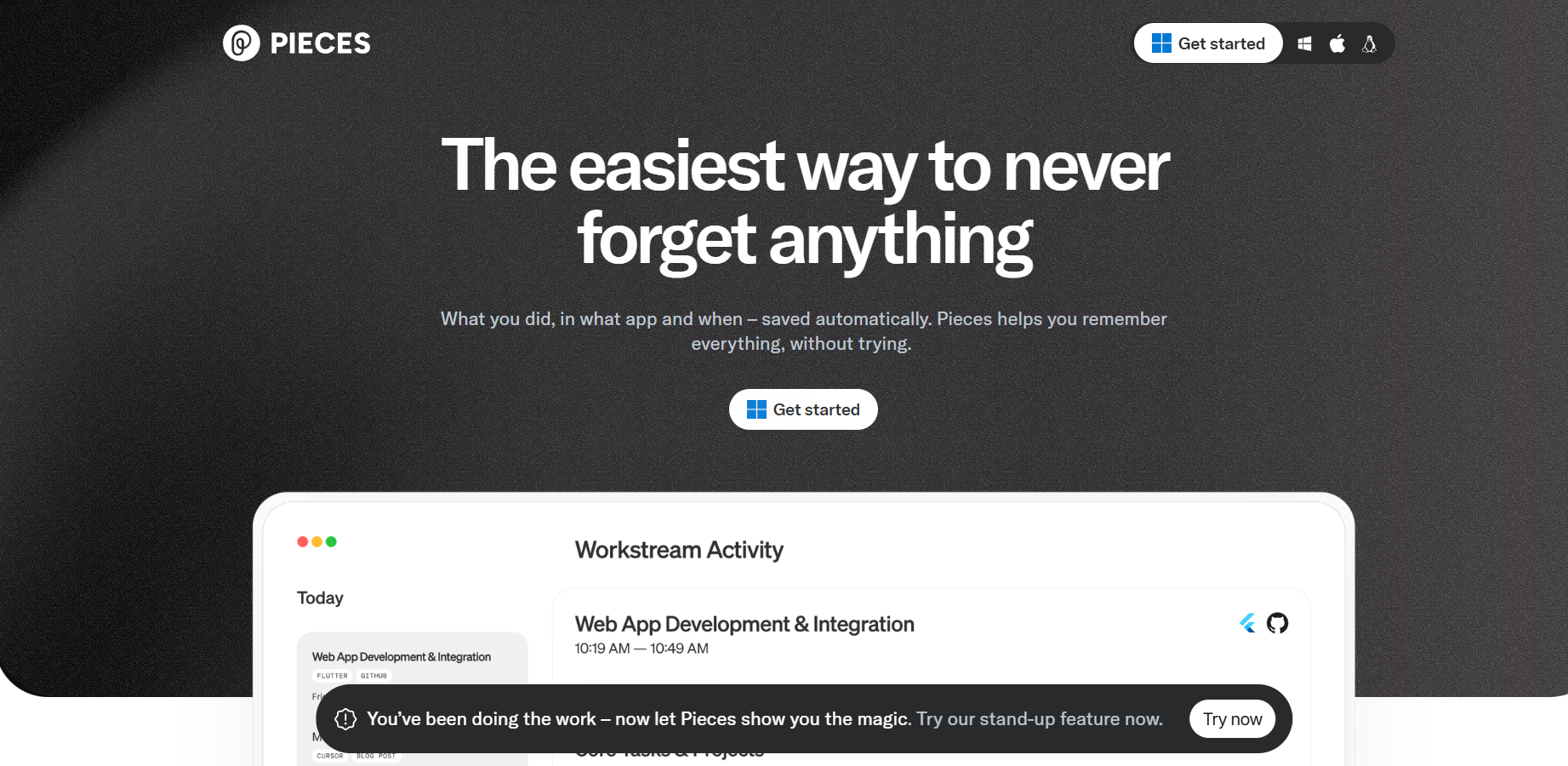
Pieces is a personal AI memory tool aimed primarily at developers. It captures context from your screen, your IDE, your browser, and your chat tools, and makes it available to AI assistants across those surfaces.
The closest analog to Supermemory's consumer app, but built around a developer's workflow rather than just chat. If your day involves jumping between VS Code, ChatGPT, Stack Overflow, and your terminal, Pieces tries to be the layer that remembers what you were doing across all of them.
Top Features
Workflow capture: Pieces tracks code snippets, browser tabs, and chat context you mark as worth saving.
IDE integrations: Plugins for VS Code, JetBrains, and others, so context is available where you are coding.
Local-first: A lot of the processing runs on your machine, which is appealing if you are wary of cloud memory tools.
Multi-model: Connects to ChatGPT, Claude, Gemini, and local models.
Pieces Pros and Cons
Pieces Pricing
Pieces is free for individual developers. Team and enterprise plans are available for organizations that need shared workspaces and advanced governance.
When to Pick Pieces Over Supermemory
If you are a developer who wants AI memory tied to your actual coding workflow, not just your chat conversations. Pieces sits closer to the IDE; Supermemory and MemoryPlugin sit closer to the chat tools.
Khoj: Personal Knowledge, Locally Hosted
Pricing: Free | Free Trial: Free self-hosted | Platforms: Desktop, Web
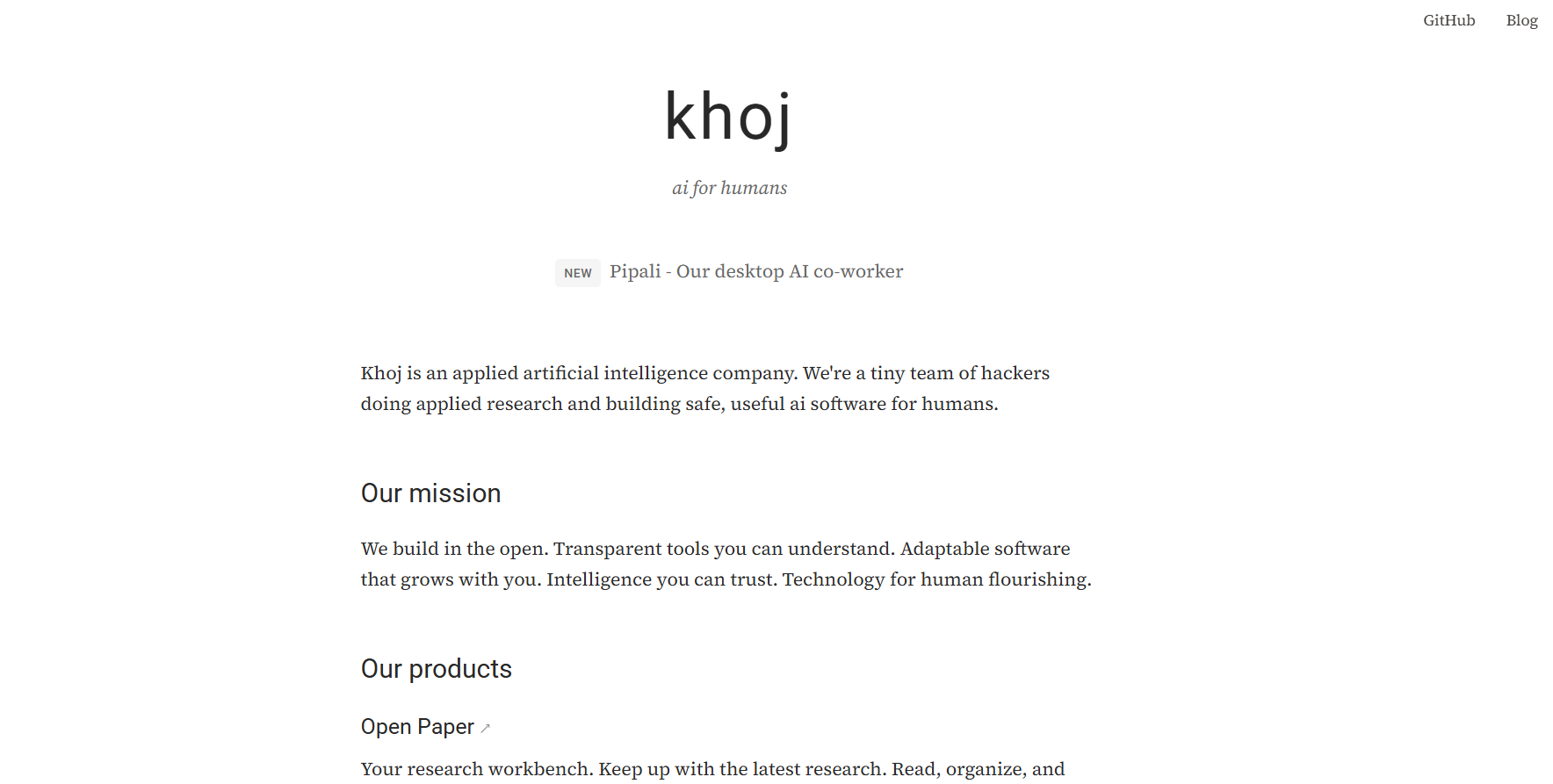
Khoj is an open-source AI assistant for personal knowledge. It indexes your Obsidian notes, Notion pages, Markdown files, and local documents, then answers questions grounded in that material.
Unlike Supermemory, which focuses on conversation-level memory for applications, Khoj focuses on the knowledge you have already accumulated. Your memory is essentially the union of your indexed corpus plus chat history.
Top Features
- Local-First Indexing: Your documents stay on your machine. Privacy is the default.
- Multi-Source Support: Connects to Obsidian, Notion, Markdown, PDFs, and more.
- Open Source: Full source code available. Self-host on your own hardware.
- Research Mode: Automatically generates insights from your accumulated notes.
Khoj Pros and Cons
Khoj Pricing
Khoj is free for self-hosted users.
Who should use Khoj?
Khoj is best for researchers, writers, and knowledge workers who want an AI that understands their accumulated notes and documents. If your memory lives in Obsidian or Notion and you want private, local-first access to it, Khoj is the right choice.
How to Choose Between Them
The seven tools above all solve a version of the same problem (AI forgets) but for different users.
Building AI agents and apps: Mem0, Letta, Zep, and Cognee are the candidates. Mem0 is the broadest. Letta is for stateful agents that manage their own memory. Zep wins on temporal reasoning. Cognee wins on knowledge graphs.
Using AI tools every day: MemoryPlugin is built for this case. Supermemory's consumer app fits here too, but is locked to fewer platforms. Khoj is a great choice for users who want private, local-first AI search across their personal notes and documents.
Developer who wants memory tied to your coding workflow: Pieces.
For most people reading a "Supermemory alternatives" guide, the question is really about whether you are building with memory or using memory. The developer tools and the consumer tools are not direct substitutes.
Your AI Memory Should Work Everywhere, Not Just One Platform
Most of the tools above do one thing well. Mem0 is a memory API. Letta is an agent framework. Zep is a temporal graph. Pieces is a developer workflow capture tool. Rewind was total recall.
MemoryPlugin solves a different problem: it is the memory layer for the person who uses ChatGPT, Claude, Gemini, and Grok every day, and wants context to follow them between tools.
If you fit that description, MemoryPlugin is the cleanest fit.