

By Alara · Facts checked November 6, 2026
Short answer: OAK.memory is associative memory infrastructure with ChatGPT and Claude plugins (ChatGPT plugin 0.1.2 published October 23, 2026), a cloud store, and an open-source engine. If you want a simpler consumer setup, local Markdown you own, or a developer memory API, these six tools are the strongest alternatives I checked in November 2026.
I make MemoryPlugin, so MemoryPlugin is on this list. I ranked the others from their own sites, not from vibes.
Want one memory in ChatGPT and Claude without wiring an engine? MemoryPlugin is built for that. See how it works →
What is OAK.memory?
OAK.memory combines vector search (finding facts by meaning) with graph links (connections between facts). It offers cloud stores and an open-source engine; its plugin update says ChatGPT plugin 0.1.2 was published on October 23, 2026, alongside a Claude cloud-store plugin.
Why look for OAK.memory alternatives?
A few patterns show up when someone searches for an alternative:
- Credits and rate limits instead of a flat "memory plan." OAK's cloud docs say signup includes 1,000 credits for 30 days, plus 50 daily free credits that do not roll over, and, as checked November 6, 2026, that "Subscription purchases are not currently available" (cloud limits). Its home page also says to check your account for "Base subscription availability," so verify current options in your account. Create, update and semantic recall cost 1 credit each.
- Builder-first product. OAK leads with vector + graph memory, local embeddings and app integration (home). That is powerful. It is more setup than a browser extension that just works in ChatGPT.
- Coverage beyond ChatGPT and Claude. OAK's published plugins focus on ChatGPT and Claude (with Claude Code, Codex and cloud connection guides on the home page). If you also live in Gemini, Cursor or other tools, you may want a wider consumer surface. Browse what MemoryPlugin covers on platforms.
- Local files you can open. Some people want memory as Markdown on disk, not only as a cloud store.
What are the best OAK.memory alternatives?
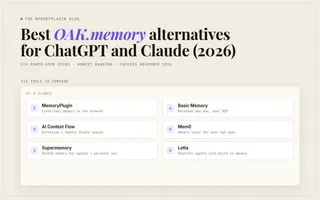
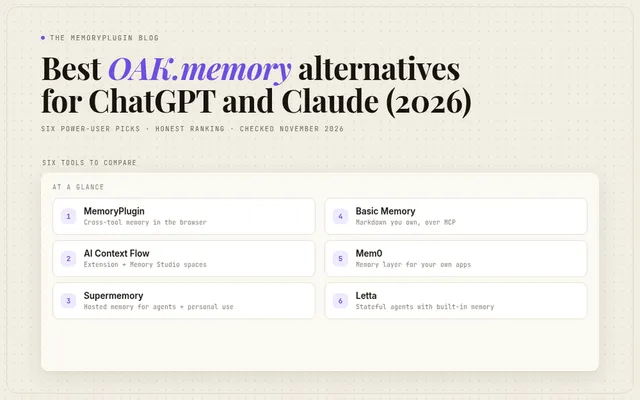
| Tool | Best for | How you connect | Pricing snapshot (Nov 2026) |
|---|---|---|---|
| MemoryPlugin | Everyday memory across the AI tools you already use | Browser extension, MCP | Paid plans; see trial note below (features) |
| AI Context Flow | Extension + shared Memory Studio spaces | Browser extension, MCP | Free; Plus $10/mo or $99/yr; Pro $20/mo or $199/yr (product page) |
| Supermemory | Hosted memory for agents, with personal use too | MCP, plugins, API | Free ($5 credits/mo); Pro $19; Max $100; Scale $399 (pricing) |
| Basic Memory | Markdown knowledge base you own | Local / cloud MCP | Free open source locally; Cloud $19/mo; Pro $99; Business $249 (pricing) |
| Mem0 | Memory layer inside your own agents and apps | API, SDK, MCP, self-host | Free tier; Custom for production (pricing) |
| Letta | Developer option: stateful agents, not a chat plugin | Letta app / API | Free: 3 stateful agents; Pro $20/mo (pricing) |
For a wider roundup, see best AI memory tools in 2026. This comparison focuses on switching from OAK.memory.
1. MemoryPlugin — best everyday alternative for ChatGPT and Claude
Best for: people who want one memory they control inside ChatGPT, Claude and their other AI tools, without building an engine.
MemoryPlugin keeps memory outside each chat's context window. You add, edit and delete memories, sort them into buckets, and use them from a browser extension. Sync brings in your Claude Code, Codex and Cursor chats and makes them searchable.
Compared with OAK.memory, MemoryPlugin is aimed at daily use in the apps you already open, not at shipping associative-memory infrastructure into your own stack.
Every subscription starts with a 7-day free trial. Try MemoryPlugin →
Example: You save the Acme launch date and tone once. The next ChatGPT chat and the next Claude chat can both see it, without pasting a brief.
2. AI Context Flow — closest like-for-like extension
Best for: saving context into project spaces and pulling it into prompts with a keyboard shortcut.
AI Context Flow (by Plurality Network) is a browser extension for ChatGPT, Claude, Gemini, Grok and Perplexity, plus an MCP server for coding tools. Context lives in Memory Studio, split into spaces you can share by viewer or editor link. Its product page lists Free, Plus ($10/mo or $99/yr) and Pro ($20/mo or $199/yr). The same page's FAQ and pricing block disagree on Free daily credit counts, so check the live pricing before you buy.
Pick this when you want spaces and prompt helpers in the browser, and you are fine managing credits.
3. Supermemory — best when agents and APIs matter
Best for: developers who want a hosted memory API, plus people who will use its MCP server and coding-agent plugins.
Supermemory positions itself as memory and continual learning for agents. Pricing is credit-based: Free includes $5 of credits each month; Pro is $19/mo; Max $100/mo; Scale $399/mo (pricing).
Pick Supermemory when you are wiring memory into agents or apps. Pick a consumer extension when your main problem is ChatGPT and Claude forgetting you between tabs. For that comparison, see best Supermemory AI alternatives.
4. Basic Memory — best if you want Markdown you own
Best for: teams and power users who want memory as plain files, readable outside the model.
Basic Memory stores knowledge as Markdown with search and a knowledge graph on top, and connects through MCP to tools such as Claude, ChatGPT, Codex and Cursor. Local use is free and open source (AGPL-3.0). Cloud starts at $19/month per workspace, with Pro at $99 and Business at $249 (pricing).
Pick Basic Memory when inspectable files matter more than a zero-setup extension.
5. Mem0 — best developer memory infrastructure
Best for: builders adding persistent memory to their own agents and apps.
Mem0 is a memory layer with a managed platform, open-source options and MCP integration. Its pricing page lists a Free plan (including 10,000 adds and 1,000 retrievals a month for the first 30 days, then higher limits with your own LLM key) and Custom plans for production (pricing).
Pick Mem0 when you are shipping product memory, not when you only need personal context in ChatGPT.
6. Letta — developer option for stateful agents, not chat plugins
Best for: developers running agents that keep their own memory as part of the agent runtime.
Letta focuses on stateful agents. Free is limited to 3 stateful agents; Pro is $20/month for personal use, with developer and teams options above that (pricing).
Pick Letta when the agent is the product. It is a weak fit if you only wanted an OAK-style plugin inside ChatGPT.
Which OAK.memory alternative should you choose?
- You use ChatGPT and Claude every day and hate re-explaining yourself. Start with MemoryPlugin or AI Context Flow.
- You want files on disk you can open in Obsidian or git. Basic Memory.
- You are building agents or an app that needs a memory API. Supermemory or Mem0.
- You want agents that stay stateful as a runtime. Letta.
- You like OAK's associative graph model and are fine with credits. Stay on OAK.memory and watch its cloud limits page for subscription availability.
Still deciding? If your pain is ChatGPT and Claude losing context between sessions, start with the consumer tools, not the developer APIs. Open MemoryPlugin →
FAQ
Is OAK.memory free?
OAK's cloud docs say signup includes 1,000 credits valid for 30 days, plus 50 daily free credits that do not roll over, and, as checked November 6, 2026, that subscription purchases are not currently available (cloud limits). Its home page also refers to Base subscription availability, so check your account for current subscription and top-up options.
Does OAK.memory work in ChatGPT and Claude?
Yes. OAK published ChatGPT plugin 0.1.2 on October 23, 2026, and a Claude plugin for cloud stores (update). Company accounts still follow each org's plugin policies.
What is the closest OAK.memory alternative for non-developers?
MemoryPlugin or AI Context Flow. Both are built around browser use in ChatGPT and Claude, with MCP for coding tools.
Can I self-host an alternative?
Basic Memory's local app is free and open source. Mem0's Open Source Overview covers its library and self-hosted server. Supermemory's self-hosting docs describe a local server binary, not an open-source server, and note that hosted MCP is not included locally. OAK also ships an open-source engine on its home page (OAK).
Will these tools stop ChatGPT forgetting earlier messages in one long chat?
They help more with facts that should survive a new chat. A single chat still has a context window. For that problem, see how to fix ChatGPT losing context.