

How to Get Better Advice From AI (It Is Not About Prompts)
AI advice feels generic because the model knows everything except you. Five habits that get you advice that actually fits your life.

Ask an AI for advice and you will get an answer that is polished, confident, and could have been written for anyone. Should you raise your prices? "Consider your value proposition, survey your customers, test incrementally." Thanks. That advice applies to a SaaS founder, a wedding photographer, and a lemonade stand.
Here is the uncomfortable part: the model is not the problem. Today's models give genuinely excellent advice when they have something to work with. The generic answer is what a genius sounds like when it knows everything about the world and nothing about you.
Prompt tricks stopped working. Context never did.
For a couple of years the internet was full of magic phrases: tell it to act as a world-class expert, promise it a tip, threaten it politely. On current models those tricks are dead weight. What actually moves answer quality is what researchers and builders now call context engineering. Andrej Karpathy describes it as carefully assembling everything the model sees before it answers. Thariq, who works on Claude Code at Anthropic, compresses it further: thin prompts, thick context.
For advice specifically, this makes intuitive sense. Good advice is mostly elimination. A good advisor rules out the options that do not fit your situation, your constraints, your history. Strip the situation away and all that is left is the full list of options, which is exactly the listicle the AI gave you.
Five habits that get you advice worth taking
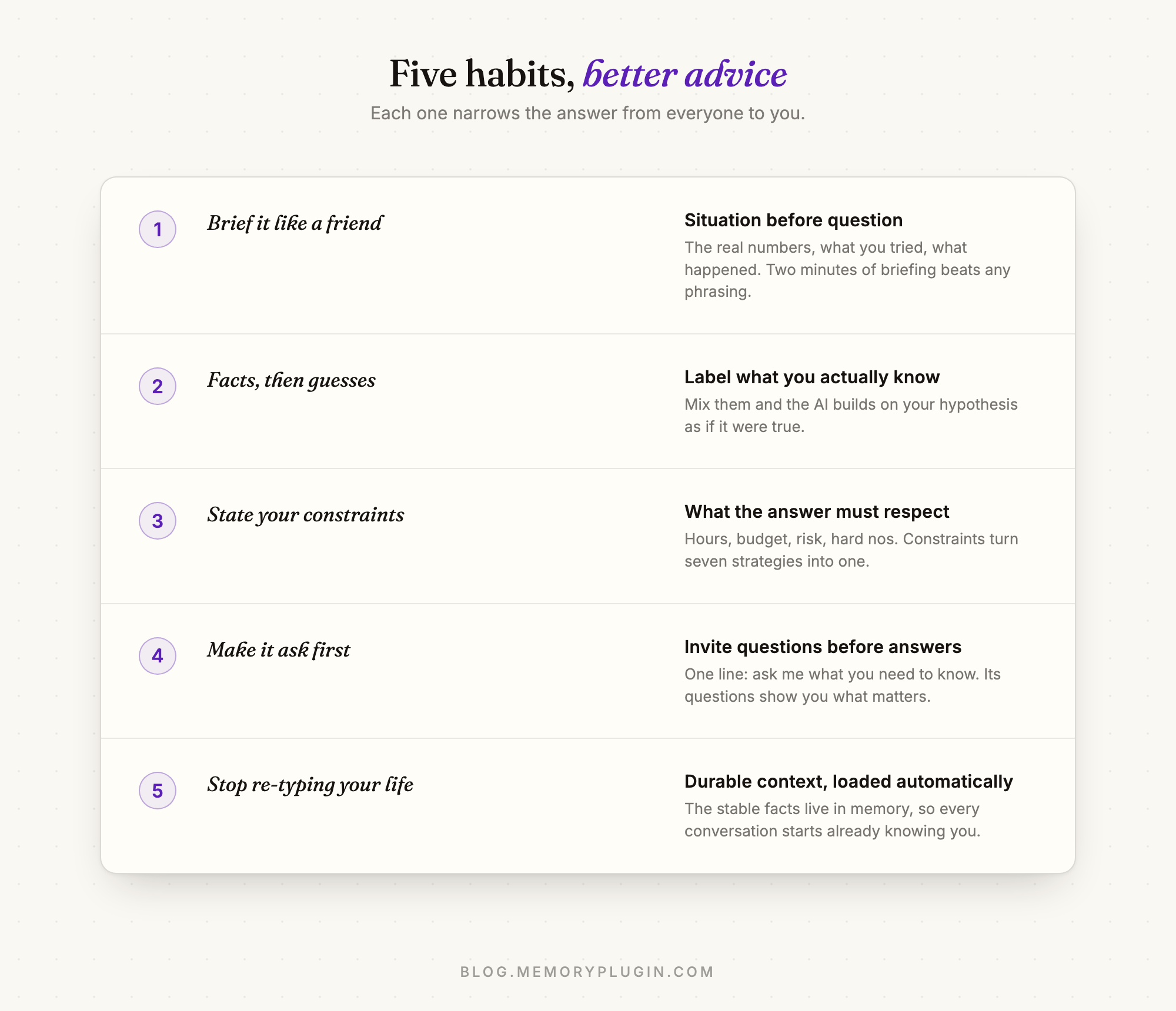
1. Brief it like you would brief a friend
Before asking the question, give the situation: what you are deciding, the real numbers, what you have already tried, and what happened when you tried it. Two minutes of briefing changes the answer more than any phrasing of the question will.
2. Separate facts from guesses
Label what you know and what you suspect. "Churn doubled in May" is a fact. "I think it is because of the price change" is a hypothesis. When you mix them, the AI builds on your guess as if it were true, and you get confident advice aimed at the wrong problem.
3. State the constraints the answer must fit
Advice that ignores your reality is trivia. Tell it what the answer has to respect: the hours you actually have, the budget, the risk you can tolerate, the things you refuse to do. Constraints are what turn "here are seven strategies" into "given your situation, do this one."
4. Make it ask before it answers
End your question with one line: "Before you answer, ask me anything you need to know to make this specific." Models are surprisingly good at knowing what is missing. The questions it asks will often show you what actually matters in the decision.
5. Stop re-typing your life
Here is where most people quietly give up. All of the above works, and all of it evaporates when the conversation ends. Tomorrow's chat starts from zero, so you compress your situation into two lazy sentences, and the generic advice returns. The fix is durable context: the stable facts about you, your work, and your history should live somewhere every conversation can draw on, instead of being retyped forever.
What this looks like with memory in place
This is the gap MemoryPlugin exists to close. Your goals, constraints, preferences, and decisions live in one memory layer, organized into buckets you control, and load into your conversations automatically across ChatGPT, Claude, Gemini, and 21+ other tools. Your past conversations become recallable too: ask "what did we conclude about pricing in March" and the answer comes back grounded in the actual discussion, even if it happened in a different AI.
The same question, before and after, looks like this:
| Without your context | With your context | |
|---|---|---|
| "Should I raise my prices?" | Seven considerations, applicable to any business on Earth | "Your churn spike in May traced to the annual cohort, not price. Your last increase held conversion steady. Raise the Pro tier, leave the entry tier alone." |
| Effort from you | Ten minutes re-explaining your business, again | Ask the question |
The second answer is not the model being smarter. It is the same model, finally briefed.
Takeaways
- Generic advice is a context problem, not a model problem. The model is not the bottleneck anymore; your context is.
- Brief before you ask: situation, numbers, what you tried, what happened.
- Keep facts and hypotheses separate, and state the constraints the answer must fit.
- Invite the AI to ask you questions before answering.
- Move the stable context out of your typing fingers and into memory, so every conversation starts already knowing you.
Context engineering, done for you: start a free 7-day trial of MemoryPlugin and stop getting advice written for everyone.