
How I give Claude Fable the right context to solve problems
The model stopped being the bottleneck. Your context is. Here's the exact prompt I use to make Claude Fable 5 recall a year of my history before it answers, and why every sentence in it earns its place.

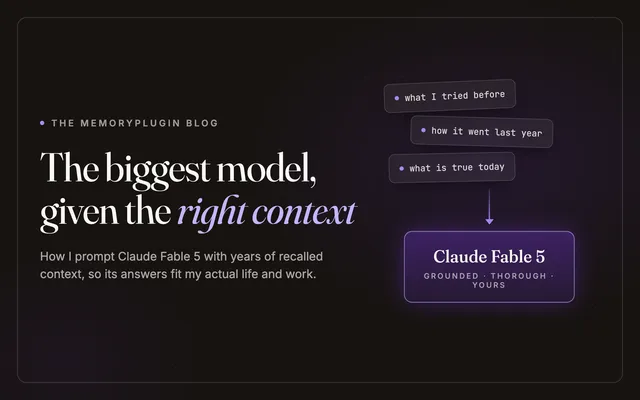
Claude Fable is the flagship of the Claude 5 family: Anthropic's biggest, smartest, most expensive model. They're calling it a step change over the previous generation, which was already very good. Whether it really is a step change, we'll see. What's not in question is that a model this size carries an enormous amount of world knowledge, and with it, better intuition on hard problems.
The catch: capability follows context. Ask a brilliant model a context-free question and you get a generic answer, beautifully phrased. The model isn't the bottleneck anymore. What you feed it is.
So this post is about how I feed it. Here's how I use MemoryPlugin to give Claude Fable 5 the context it needs to solve my actual problems, not the average internet user's problems.
Why context is the whole game
Not every query needs rich context. "Convert this to a for loop" doesn't care who you are. But many queries produce completely different answers with and without the right background, and the difference isn't subtle. Strategy questions, health questions, anything touching your business, your finances, your history: the answer that fits you depends on facts about you.
And here's the problem: the right context might span back years and touch a dozen areas of your life and work. There is no way you're sitting in front of Claude typing out a 3,000-word essay to build the perfect prompt. I wouldn't either, and I do this for a living.
The thing is, you've almost certainly already discussed most of that context with your AI tools at some point. It's sitting in old conversations. MemoryPlugin makes that history available to all your AI tools, including Claude Fable 5 through our MCP server. So instead of writing the context, I point the model at it.
The prompt
Here's a real prompt, the kind I actually send:
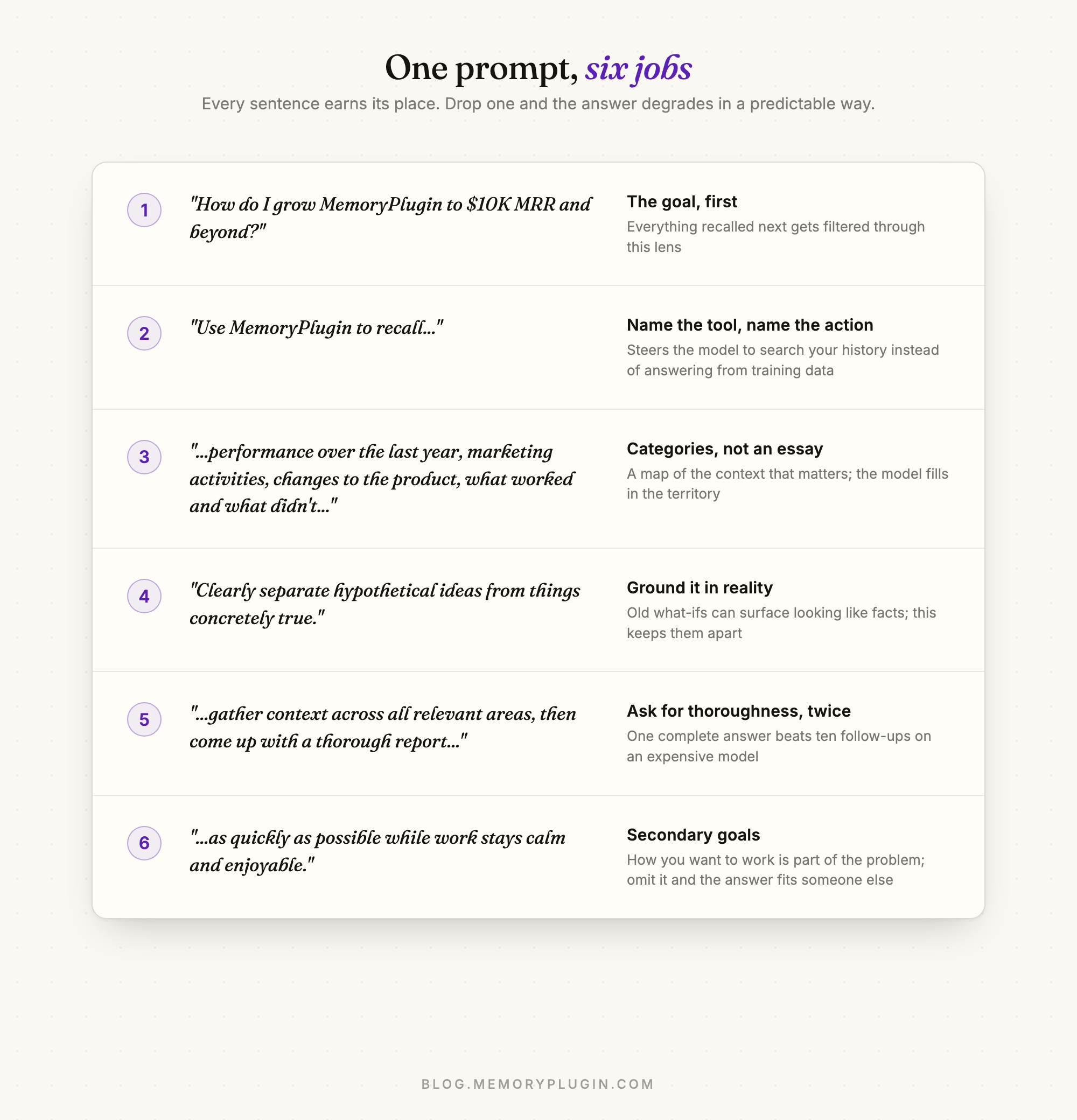
How do I grow MemoryPlugin to $10K MRR and beyond? Use MemoryPlugin to recall details about the performance over the last year, marketing activities, changes to the product, changes to the market, things I've tried that worked and ones that didn't, how things have evolved over time. Clearly separate hypothetical ideas discussed in the abstract from things concretely true. Gather context about my current life across all relevant areas, then come up with a thorough report that I can implement to grow to my target as quickly as possible while work stays calm and enjoyable.
Five sentences. But each one is doing a specific job, and leaving any of them out degrades the answer in a predictable way.
Taking it apart
The goal comes first. "How do I grow MemoryPlugin to $10K MRR and beyond?" Everything the model recalls and reasons about afterward gets filtered through the lens of this goal. State it plainly, state it early.
Name the tool, name the action. "Use MemoryPlugin to recall." Both words are load-bearing. MemoryPlugin's chat history search is a tool called recall, and naming it steers the model to actually reach for it instead of answering from its training data. Models have lots of tools available; nudging them toward the right one is often necessary, and it costs you three words.
Sketch the context you think matters. Performance over the last year, marketing activities, product changes, market changes, what worked and what didn't. I'm not writing the context, I'm writing the categories of context. The model takes it from there: it fires off recall queries, expands into related topics, maybe mixes in web searches. I gave it a map, not the territory.
Make it separate fact from hypothetical. This is the sentence most people wouldn't think to include, and it might be the most important one. Your chat history is full of ideas you discussed in the abstract, plans you floated and abandoned, hypotheticals you gamed out. An unsolved problem for every AI memory tool, ours included, is that recalled hypotheticals can surface looking like things that actually happened. On a high-stakes query, that leads your AI genuinely astray. Telling the model to clearly separate the two makes it noticeably more careful: it double-checks, it hedges where it should, and the answer comes back grounded in what's real.
Ask for thoroughness, once more with feeling. Fable is expensive. You want the full answer in one reply, not spread across ten follow-ups. So I say thorough, and you'll notice I also ask a second time to gather context "across all relevant areas". Repeating an instruction you care about isn't bad prompting, it's emphasis, and models respond to it.
State the secondary goals. "As quickly as possible while work stays calm and enjoyable." Without that clause I get the hustle-culture answer: run paid ads, post daily on five platforms, launch three funnels. Technically responsive, practically useless, because it ignores how I want to work. Secondary goals and preferences are the difference between an answer that looks impressive and one you'll actually implement.
What comes back
With the context recalled and the guardrails set, what I get isn't generic advice. It's a report that cites what I tried last spring, knows which channel actually converts for me, remembers what I said I'd never do again, and fits the way I want to run my work. The difference between that and the blank-slate answer is the difference between advice from a longtime friend and advice from a stranger at a conference.
This works everywhere Claude does: claude.ai on web and mobile, the desktop apps, and Claude Code, all through the same MemoryPlugin MCP connection. Same memory, every surface.
Key takeaways
- The model stopped being the bottleneck, your context is - A frontier model with no background produces beautiful generic answers. Feed it your history and the same model produces answers that fit your life
- Don't write the context, point at it - You've already discussed most of what matters in past AI conversations. Recall beats retyping
- Name the tool and the action - "Use MemoryPlugin to recall" reliably steers the model to the right tool. Nudges are cheap; use them
- Give categories, not an essay - List the kinds of context that matter and let the model expand from there
- Separate fact from hypothetical - Chat history contains both. On high-stakes queries, tell the model to keep them apart; it gets visibly more careful
- State your secondary goals - How you want to work is part of the problem. Leave it out and you'll get an answer built for someone else
If you want your AI tools to know you like this, MemoryPlugin is one shared memory across ChatGPT, Claude, Gemini, and 20+ other AI tools. Your context follows you, whichever model you're talking to.