
Anthropic Rewrote the Rules of Context Engineering. Quality Mode Applies Them for You.
Anthropic cut 80 percent of Claude Code's prompt and rewrote the rules of context engineering. Quality mode applies the same discipline to your conversations.

Anthropic published something quietly radical yesterday: new rules of context engineering for the Claude 5 generation, written by Thariq Shihipar. The headline detail is that they removed over 80 percent of Claude Code's system prompt for the new models with no measurable loss. The instructions were not helping. The context was.
The rules that replace all that prompt text share one theme: stop micromanaging the model and start curating what it sees. Give it judgment instead of rules. Load context progressively, when it is needed, rather than everything upfront. Prefer automatic memory over manually maintained files. Hand it rich references instead of thin specs.
Those rules are addressed to people building on Claude. But read them again as a person who just uses AI every day, and they describe your problem too.
Your conversations have the same context problem
Every conversation you start is a small context engineering exercise. What does this chat need to know about you, your project, your history, your constraints? Most people solve it the manual way: re-typing background, pasting old notes, keeping a personal briefing document they paste at the top of every chat. That is the conversational equivalent of the bloated system prompt Anthropic just deleted: assembled by hand, always stale, mostly ignored.
The fix is the same one the new rules prescribe for builders. Curate less by hand. Retrieve the right things automatically.
What quality mode actually does
MemoryPlugin's recall has two modes. Speed mode answers quick lookups in a few seconds. Quality mode is the context engineer: slower, and built for the questions where getting the right context matters more than getting it fast. Under the hood it works the way the new rules say context should be built:
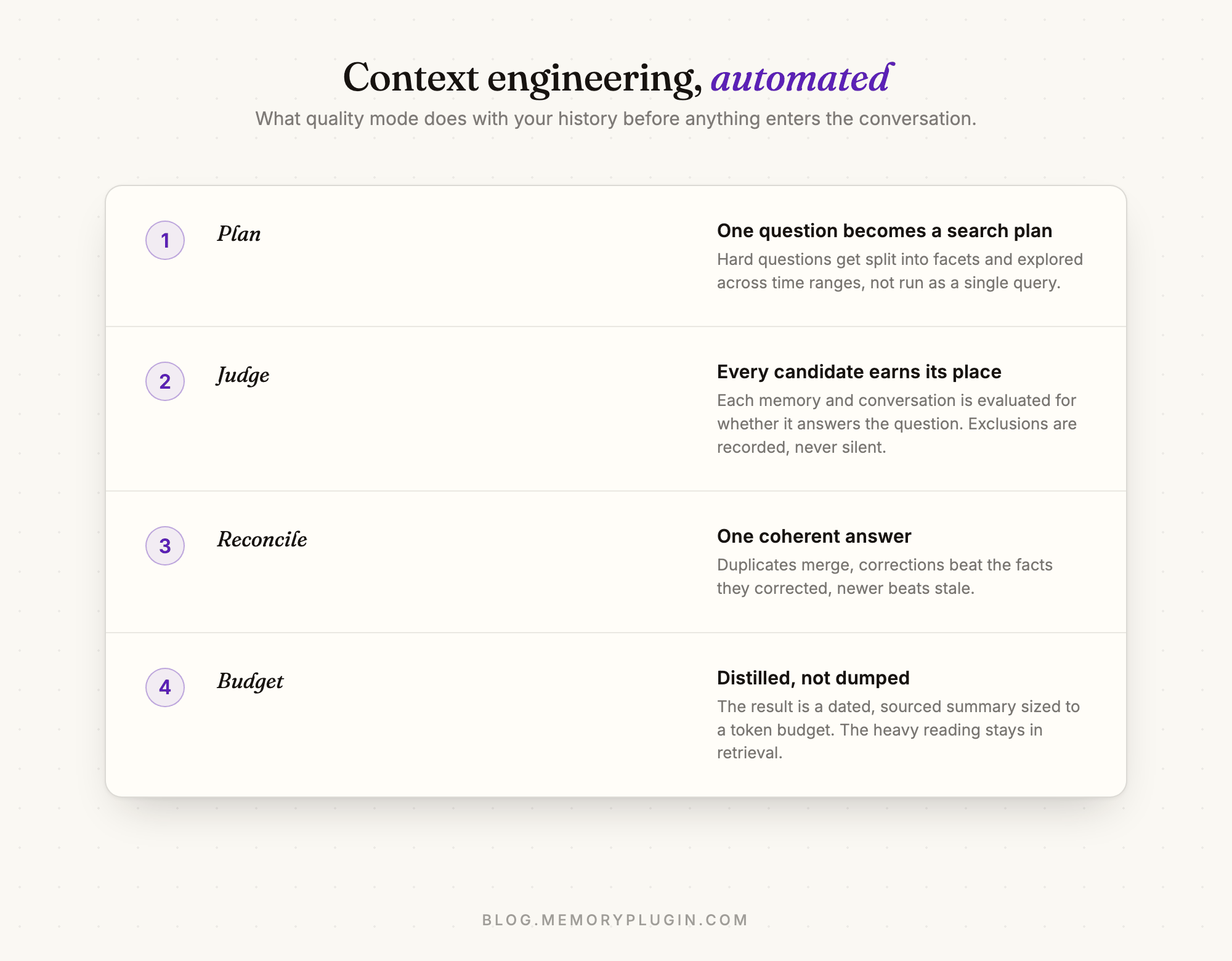
- It plans the search instead of running one query. A hard question gets broken into facets, and your history is explored across time ranges, not just matched on keywords. Ask about how a project evolved and it looks at the beginning, the middle, and last week.
- It judges, it does not just rank. Every candidate memory and conversation gets evaluated for whether it actually answers the question. Similar-looking but irrelevant context gets excluded, and exclusions are recorded rather than silently dropped.
- It reconciles instead of dumping. Duplicates get merged, corrections win over the facts they corrected, and newer information outranks stale information. You get one coherent answer, not five conflicting fragments.
- It writes context, not logs. What enters your conversation is a synthesized, dated summary with sources you can check, in prose when your history is a story and in facts when it is a lookup.
- It fits a budget. What comes back is sized to a token budget rather than flooding the conversation. The heavy reading happens during retrieval; your context window only gets the distilled result.
That is the same shape as Anthropic's advice to builders: thin prompts, rich retrieved context, judgment at retrieval time, automatic memory underneath.
When to use which mode
Speed mode for "what was the dosage again" and "which library did we pick." Quality mode for "how did my thinking on pricing evolve," "summarize what we know about this client," or anything where the answer lives across many conversations and months. You pay a few extra seconds; you get context that was engineered rather than fetched.
The takeaway
The context engineering era is not just for people writing system prompts. The same discipline that made Claude Code better by deleting 80 percent of its instructions makes your daily AI better too: keep your durable context outside any single tool, and let retrieval, not typing, decide what each conversation sees. That is what MemoryPlugin is for. Context engineering, done for you: start a free 7-day trial.